Reliable electricity is essential for rural households, agricultural activities, small businesses, and community infrastructure. However,…
India has strong wind-energy potential, but the right location for a Small Wind Turbine depends on more than the state’s overall wind capacity. Small systems are often installed at lower heights than utility-scale turbines, making local wind flow, terrain, nearby obstacles, mounting conditions, and energy requirements especially important.
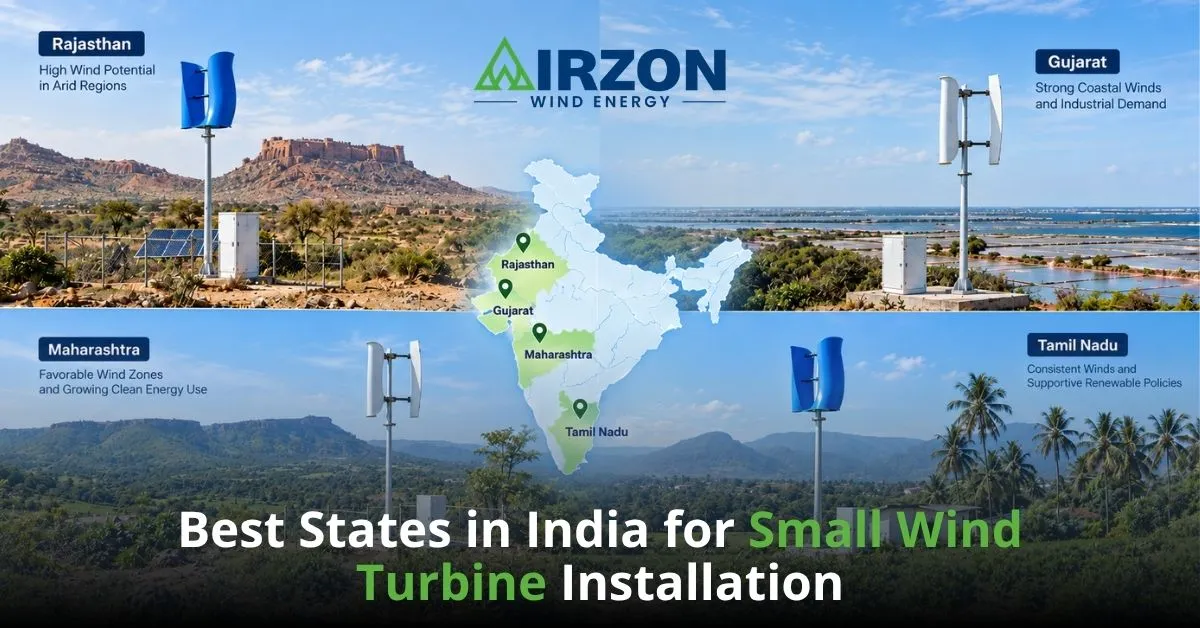
Maharashtra, Gujarat, Tamil Nadu, and Rajasthan stand out for different combinations of wind conditions, geography, decentralized applications, and hybrid renewable-energy potential. However, the best result still comes from assessing the specific installation site rather than selecting a state alone.
What Makes a State Suitable for Small Wind Turbine Installation?
A Small Wind Turbine generally operates much closer to ground level than a large utility-scale machine. This makes low-altitude wind quality particularly important. Coastal breezes, mountain gaps, open plains, and areas with limited turbulence can create more favorable conditions.
A practical site assessment should consider average wind speed, turbine height, surrounding buildings and trees, terrain, structural strength, electricity demand, and the possibility of combining wind with solar and battery storage.
One useful benchmark in small-wind site assessment is an annual average wind speed of around 4.17 m/s at 20 metres, although actual suitability depends on the turbine’s power curve, site conditions, and project requirements.
Maharashtra: Strong Potential for Distributed Wind
Maharashtra is notable for its combination of Western Ghats terrain, coastal areas, agricultural regions, and growing interest in decentralized renewable-energy applications. These varied conditions create opportunities for a Small Wind Turbine when the individual site has suitable wind resources and minimal turbulence.
The Sahyadri ranges around districts such as Satara and Sangli contain elevated terrain and gaps that can influence local wind flow. The Konkan region also provides exposure to coastal breezes, creating opportunities that can differ significantly from those in dense urban areas.
Maharashtra can also be attractive for solar-wind hybrid systems. During the monsoon season, reduced solar availability can coincide with stronger wind conditions, allowing the two resources to complement each other in appropriately assessed locations.
State renewable-energy institutions and an established clean-energy ecosystem can also make installation, servicing, and technical support more accessible in suitable areas, helping users implement and maintain a Small Wind Turbine system more effectively.
Gujarat: Coastal Conditions and Hybrid Applications
Gujarat offers a particularly important advantage for decentralized wind because of its extensive coastline and open terrain. Coastal areas of Kutch, Saurashtra, Jamnagar, Porbandar, and nearby regions can provide useful wind exposure for correctly positioned systems.
For a Small Wind Turbine, coastal locations can be attractive because wind may remain accessible without relying exclusively on very tall towers. However, marine exposure also introduces challenges such as salt, corrosion, and moisture, making equipment selection and maintenance important.
Gujarat is also well suited to applications where wind can complement solar, particularly for remote facilities, agricultural operations, coastal properties, and other locations where reliable, decentralized electricity is required.
Tamil Nadu: Established Wind-Energy Infrastructure
Tamil Nadu has a long association with India’s wind sector and benefits from distinctive geographic features. Wind corridors around the Palghat and Shencottah gaps influence airflow across surrounding areas, while districts such as Kanyakumari, Tirunelveli, Thoothukudi, and parts of Coimbatore have significant wind-energy activity.
For a Small Wind Turbine, open agricultural and rural locations can be particularly relevant where wind flow is less disturbed by buildings and trees. The state’s established wind-energy ecosystem can also support installation, servicing, electrical integration, and maintenance requirements.
Site-specific wind assessment remains essential because strong regional wind potential does not guarantee suitable conditions at every individual property.
Rajasthan: Open Terrain for Decentralized Wind
Rajasthan presents a different type of opportunity for a Small Wind Turbine. Instead of coastal breezes or mountain gaps, many areas offer broad, open terrain with relatively few obstacles. Regions around Jaisalmer, Jodhpur, Barmer, and other open districts can provide conditions where wind movement is less disrupted by dense vegetation or buildings.
Another advantage is the potential for combining wind with solar. Rajasthan has strong solar resources, while wind availability can vary by time of day and season. A properly designed hybrid system can therefore help diversify renewable generation rather than depending on one resource alone.
Agricultural properties, remote sites, farmhouses, and other off-grid applications may benefit from a Small Wind Turbine where the measured wind resource supports reliable turbine operation. Site assessment remains important to determine whether the available wind speed, turbine height, and surrounding conditions are suitable.
Which State Is Suitable for Which Application?
| State | Key Advantage | Potential Applications |
| Maharashtra | Western Ghats and coastal wind zones; hybrid potential | Farmhouses, decentralized systems, suitable urban/peri-urban sites |
| Gujarat | Extensive coastline and open wind corridors | Coastal properties, agriculture, remote and hybrid systems |
| Tamil Nadu | Established wind corridors and technical ecosystem | Rural farms, MSMEs, decentralized power systems |
| Rajasthan | Open terrain with strong solar-wind complementarity | Farmhouses, agriculture, remote and off-grid applications |
What Should You Check Before Installing a Small Wind Turbine?
State-level potential is only the starting point. A Small Wind Turbine should be installed where measured wind conditions and site geometry support useful energy generation.
The proposed location should be checked for nearby trees, buildings, towers, and transmission lines that can create turbulence. A practical micro-site guideline is to maintain sufficient clearance from significant obstacles, with the supplied reference recommending consideration of a 100-metre radius around the turbine location.
Rooftop projects require another layer of evaluation. The terrace or mounting structure should be assessed for the turbine’s weight, dynamic loads, vibration, and anchoring requirements. A standard two-storey home surrounded by substantially taller buildings may have poor wind exposure even when the wider city appears windy.
Planning a Small Wind Turbine installation in India? Contact us today to discuss your site conditions and renewable energy requirements.
Why Site Assessment Matters More Than State Selection?
The same state can contain excellent and unsuitable locations for wind generation. A coastal district does not mean every rooftop has useful wind, just as an open desert location does not automatically guarantee sufficient wind at turbine height.
Before installation, assess the wind resource, proposed turbine height, surrounding obstacles, structural conditions, energy demand, electrical configuration, and maintenance access. These factors ultimately determine whether a Small Wind Turbine is technically appropriate for the application.
Expert Tips for Choosing a Small Wind Turbine Site
Choosing the right site is essential for Small Wind Turbine performance. Consider wind speed, tower height, surrounding obstacles, land conditions, and accessibility before installation.
Avoid the Himalayan Trap
Northern hilly states such as Himachal Pradesh and Uttarakhand may appear windy, but wind conditions can vary significantly across valleys because of terrain, wind shear, and turbulence. For a Small Wind Turbine, coastal areas and open western regions may offer more suitable conditions in locations where wind measurements confirm consistent airflow. The actual site should always be evaluated rather than selecting a location based only on regional geography.
Understand the Rooftop Myth
A rooftop can look like a convenient location for a Small Wind Turbine, but surrounding buildings can significantly disturb and reduce usable wind flow. A standard two-storey home surrounded by taller structures may experience turbulent or masked airflow, making the installation less productive. Open rooftops, elevated locations, or coastal high-rise sites with clear wind exposure can be more suitable when supported by proper wind assessment and structural evaluation.
Frequently Asked Questions
Maharashtra, Gujarat, Tamil Nadu, and Rajasthan offer different combinations of wind resources, open terrain, coastal conditions, and decentralized renewable-energy opportunities.
No. Small systems operate at lower heights, so local wind speed, turbulence, obstacles, mounting height, and site conditions are especially important.
Yes. Wind-solar hybrid systems can combine two renewable resources and may be useful for off-grid, agricultural, remote, and other decentralized applications.
No. Rooftop suitability depends on wind exposure, surrounding obstacles, structural capacity, vibration, mounting design, and local requirements.
A site should be evaluated using measured or reliable wind-resource data at the proposed turbine height. A reference benchmark of around 4.17 m/s at 20 metres can be considered, but turbine-specific performance and site conditions must also be assessed.
Conclusion
Maharashtra, Gujarat, Tamil Nadu, and Rajasthan each offer distinct opportunities for Small Wind Turbine installations. Maharashtra combines varied terrain and hybrid potential, Gujarat benefits from extensive coastal exposure, Tamil Nadu has established wind-energy infrastructure, and Rajasthan provides open terrain with strong solar-wind possibilities.
The final decision should always be based on the individual site’s wind resource, turbine height, obstacle clearance, structural suitability, energy demand, and system configuration. Careful site assessment is what turns regional wind potential into a practical renewable-energy installation.
Related Posts