
Agricultural irrigation often requires dependable power for lifting and distributing water, particularly in remote areas…
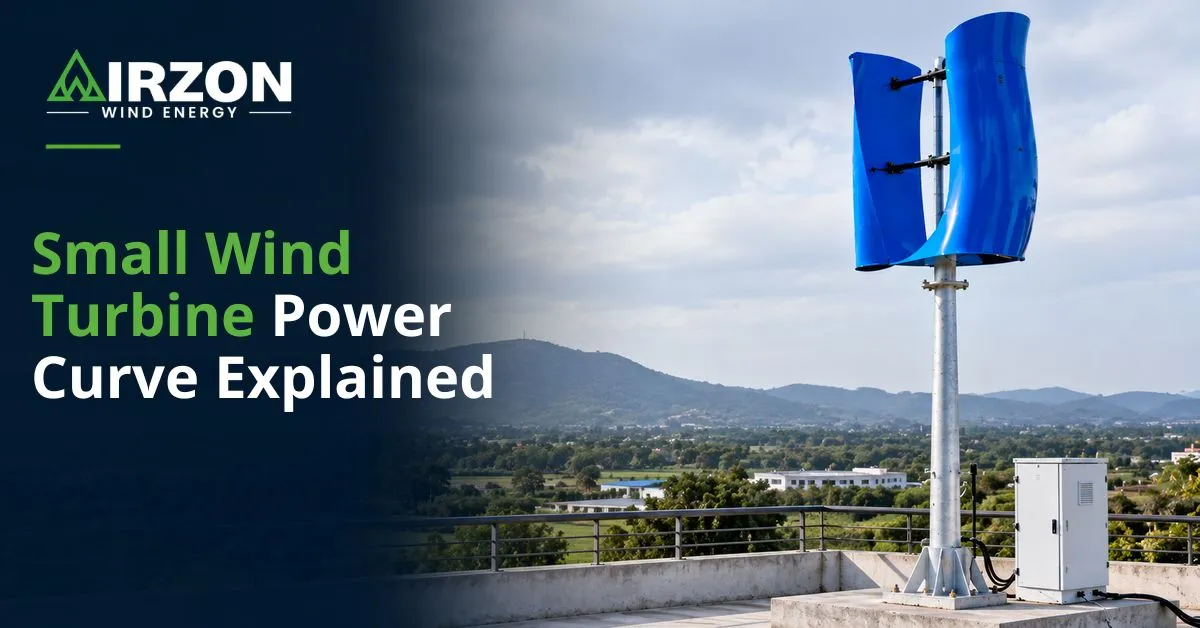
A power curve is one of the most useful technical tools for understanding how a Small Wind Turbine responds to changing wind speeds. It shows the relationship between wind velocity and the electrical power produced by the turbine, helping users understand when generation begins, how quickly output increases, when rated power is reached, and when the turbine must shut down for protection.
Understanding the power curve is important when evaluating turbine performance, comparing models, and assessing whether a particular wind resource is suitable for an installation.
What Is a Small Wind Turbine Power Curve?
A Small Wind Turbine power curve is a graph that plots wind speed on the horizontal axis and electrical power output on the vertical axis. The curve illustrates how much electricity the turbine can produce at different wind velocities under the conditions used for the manufacturer’s performance testing.
The curve generally progresses through several important operating stages: cut-in wind speed, ramp-up or partial-load operation, rated wind speed and power, and cut-out wind speed.
What Is Cut-in Wind Speed?
Cut-in wind speed is the minimum wind velocity at which the turbine begins rotating and producing usable electrical power. Below this point, the available wind energy is insufficient for normal electricity generation.
On the power curve, this is where the output begins moving upward from zero. For a Small Wind Turbine, the actual cut-in speed depends on its design and operating characteristics, making this specification important when evaluating expected performance.
The cut-in speed should be checked against the manufacturer’s technical specifications to understand the wind conditions required before the turbine begins generating usable electricity.
What Happens During the Ramp-Up Zone?
After the turbine passes its cut-in speed, electrical output increases as wind speed rises. This section of the power curve is often called the ramp-up or partial-load region.
The underlying kinetic energy available in moving air is strongly influenced by wind speed. In simplified form, available wind power is proportional to the cube of wind velocity:
P = ½ ρAV³Cp
Here, ρ represents air density, A represents the swept area, V represents wind speed, and Cp represents the turbine’s power coefficient.
Because wind speed appears as a cube in this relationship, changes in wind velocity can have a substantial effect on available wind power. However, the actual electrical output of a Small Wind Turbine depends on its aerodynamic, mechanical, and electrical characteristics rather than following the theoretical relationship without losses.
What Are Rated Wind Speed and Rated Power?
As wind speed continues to increase, the turbine eventually reaches its rated wind speed. At this point, the turbine reaches its specified rated power, the maximum intended continuous output under the manufacturer’s operating conditions.
Once rated power is reached, the turbine does not simply continue increasing electrical output indefinitely as wind speed rises. Control mechanisms can regulate the turbine’s operation to prevent excessive loads and protect the generator and other mechanical components.
This section of the power curve is particularly useful when comparing the rated performance of different Small Wind Turbine models.
What Is Cut-out Wind Speed?
Cut-out wind speed is the upper operating limit at which a Small Wind Turbine stops normal generation to protect itself from excessive wind loading.
When wind conditions exceed this threshold, the turbine can use braking, furling, blade control, or other protective mechanisms depending on its design. The purpose is to reduce mechanical and structural loads during extreme wind conditions.
The cut-out point is therefore an important safety feature rather than an indication of reduced turbine performance.
Want to understand which Small Wind Turbine performance characteristics suit your site? Contact us today to discuss your wind-energy requirements.
How Does a Power Curve Help Select a Small Wind Turbine?
A power curve should be considered alongside the actual wind conditions at the proposed installation site. Looking only at a turbine’s rated power can provide an incomplete picture of its expected performance.
For a Small Wind Turbine, users should examine:
- Cut-in wind speed
- Wind speed at rated power
- Rated electrical output
- Cut-out wind speed
- Output across the expected operating wind-speed range
- Site-specific wind conditions
The most useful turbine is not necessarily the one with the highest rated output. Its power curve should correspond reasonably well with the wind conditions available at the installation site.
Why Does the Factory Power Curve Differ from Real-World Output?
A manufacturer’s power curve provides valuable performance information, but actual energy production at a site can differ from the published curve.
Real installations may experience turbulent airflow caused by buildings, trees, terrain, or other obstacles. This is particularly important for small turbines installed at relatively low heights, where the rotor can operate within more complex local wind conditions.
Air density can also vary with elevation and atmospheric conditions. As a result, the actual output of a Small Wind Turbine may differ from performance measured under standardized testing conditions.
Site assessment is therefore essential when estimating real-world energy production rather than relying solely on a factory power curve.
How Should You Read a Small Wind Turbine Power Curve?
Reading the curve becomes easier when you follow it from left to right:
- Below cut-in: The turbine produces little or no usable electricity.
- After cut-in: Output begins increasing as wind speed rises.
- Ramp-up region: Electrical output increases substantially with increasing wind speed.
- Rated point: The turbine reaches its specified rated power.
- Above rated speed: Control systems limit output and manage operating loads.
- At cut-out: The turbine shuts down or enters a protective mode during excessive wind conditions.
This progression provides a simple way to understand how a Small Wind Turbine behaves across different wind speeds.
Why Is Site Wind Assessment Important?
A power curve describes turbine performance, but it does not tell you how much wind your specific location will receive. For a Small Wind Turbine, that requires a separate assessment of the site’s wind resource.
Nearby buildings, trees, terrain, mounting height, turbulence, and local atmospheric conditions can influence the wind reaching the rotor. A turbine may therefore have an attractive published power curve but produce less energy than expected if the installation site has insufficient or highly turbulent wind.
The U.S. Department of Energy’s Small Wind Guidebook is also provided in the reference material as a resource for small-wind planning and siting considerations.
Frequently Asked Questions
It is a graph showing the relationship between wind speed and the electrical power produced by a turbine at different operating velocities.
Cut-in wind speed is the minimum wind speed at which a turbine begins rotating and producing usable electrical power.
Rated wind speed is the wind velocity at which the turbine reaches its specified rated power under the applicable operating conditions.
The cut-out point provides protection during excessively high winds by stopping or limiting turbine operation to reduce mechanical and structural loads.
No. Actual output depends on the site’s wind conditions, turbulence, air density, turbine installation, and other factors. The manufacturer’s curve should therefore be considered alongside a site-specific wind assessment.
Conclusion
A Small Wind Turbine power curve provides a clear way to understand how turbine output changes as wind speed increases. The curve moves through four important stages: cut-in, ramp-up, rated operation, and cut-out. Understanding these stages helps users evaluate turbine specifications and compare performance characteristics.
However, a published power curve is only one part of the assessment. Actual energy production from a Small Wind Turbine depends on the wind conditions, site characteristics, and installation environment. Combining the power curve with proper site assessment provides a more realistic basis for selecting, sizing, and evaluating a small wind energy system.
Related Posts